
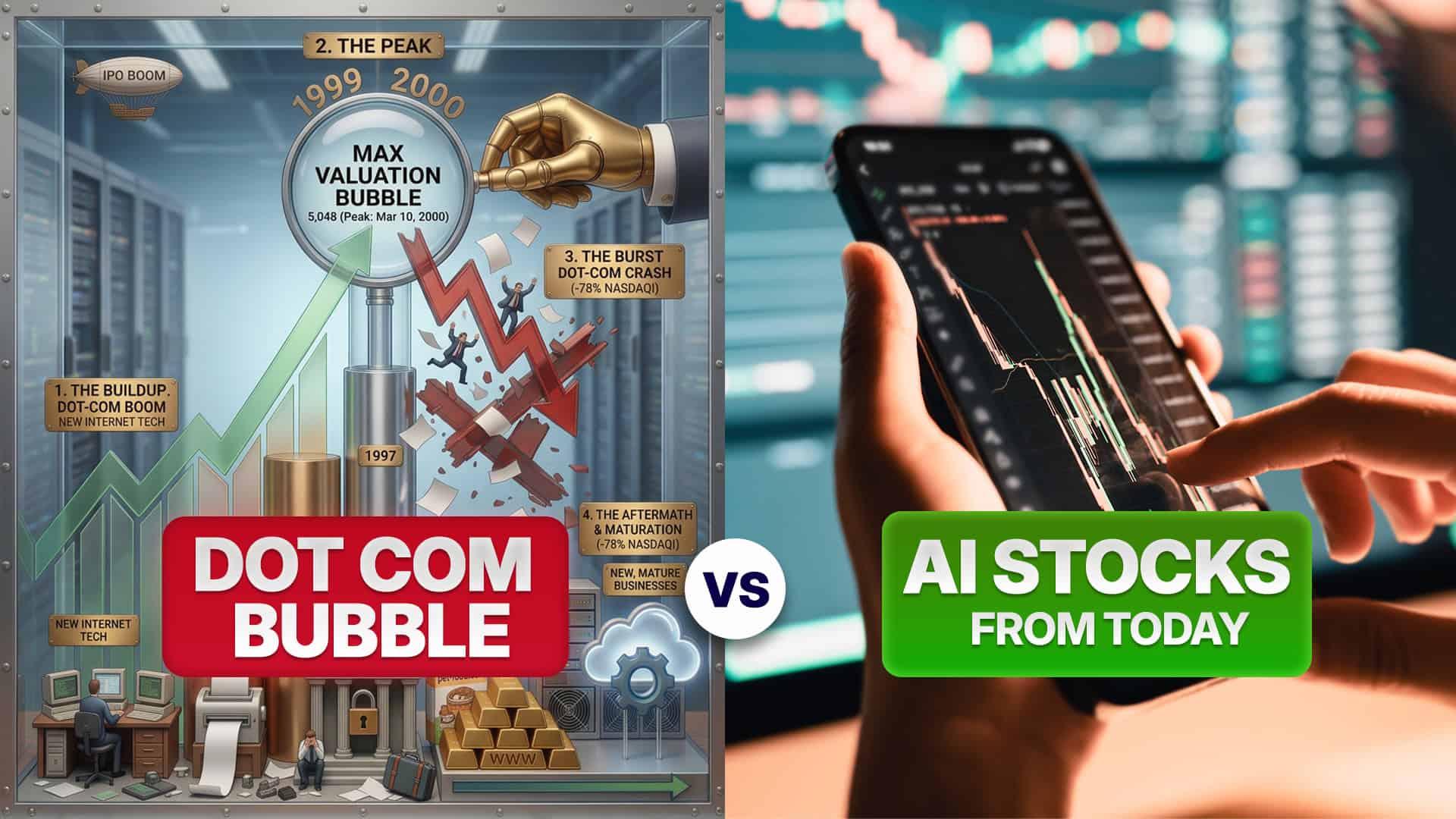

The debate around the Dot-Com Bubble vs AI Stocks from Today is growing among investors. Artificial intelligence has created huge interest across the stock market. Companies are investing billions in AI tools, chips, data centers, and software. At the same time, investors are looking for the next big winner. This excitement has led many people to compare AI stocks with the internet stocks of the late 1990s. However, the two periods are not exactly the same. The dot-com b oom included many companies with little revenue and weak business models. Today, many leading technology companies already have large customer bases and strong cash flows. Still, that does not mean every AI stock is a good investment. Investors should look beyond the excitement and study the businesses behind the trend. The biggest opportunities may come from companies that provide the tools and infrastructure AI needs to grow.
What Was the Dot-Com Bubble?
The comparison between the Dot-Com Bubble vs AI Stocks from Today starts with the internet boom of the late 1990s. Investors believed the internet would change business and everyday life. They were correct about the technology. However, many investors paid too much for companies that had not proven their business models. Many internet companies had little revenue. Some had no profits at all. Others had unclear plans for making money. Despite these problems, their stock prices continued to rise. Investors feared missing out on the next big winner. As a result, valuations reached levels that businesses could not support. The bubble finally burst in 2000, and may companies failed soon after, and if they didn’t, they saw their share prices plummet. Yet the internet itself did not fail. It became one of the most important technologies in modern life. The key lesson is simple. A powerful technology does not automatically make every related stock a good investment.
Why AI Creates Similar Excitement
The Dot-Com Bubble vs AI Stocks from Today discussion also highlights the excitement surrounding new technology. Artificial intelligence has created attention among businesses, investors, and consumers. Companies now use AI for research, customer service, coding, marketing, and data analysis. Therefore, demand for AI technology continues to grow. Investors have noticed this growth and started looking for companies that could benefit. However, excitement can create problems when stock prices rise faster than business results. A company can have an exciting AI story and still be a weak investment. During the dot-com boom, many businesses added internet-related language to their plans. That helped attract attention and investment. Today, investors face a similar challenge with AI. They must separate the technology from the investment opportunity. AI may become essential across many industries. Still, only some companies will turn that growth into lasting shareholder value.
The Biggest Difference Between Then and Now
One major difference between the Dot-Com Bubble vs AI Stocks from Today is the strength of today’s largest AI companies. Many leading AI businesses already operate successful companies. They have real customers, established products, and significant revenue. Nvidia, for example, sells advanced processors used for demanding computing tasks. Microsoft has a large software and cloud business that supports AI development and use. Other companies provide networking, power, cooling, storage, and data center services. As a result, today’s AI economy rests on a much larger business foundation. That foundation does not mean AI stocks cannot become overpriced. Even an excellent company can become a poor investment when investors pay too much. Therefore, investors should ask one big question. Will AI demand continue to grow? In my opinion, the answer is yes. Both consumers and businesses will continue using AI.
The Gold Rush Offers an Important Lesson
The current AI market also shares similarities with the California Gold Rush. During the 1850s, thousands of people traveled west hoping to find gold. Many believed they could become wealthy by discovering valuable deposits. However, most miners did not become rich. The people who became rich were the entrepreneurs who created tools to support gold miners. They sold tools, clothing, food, and other supplies. For example, Levi Strauss became famous for making durable clothing for miners. The broader lesson still applies today. People often focus on the headline opportunity. However, the businesses supporting that opportunity are typically the bigger play. AI has created a similar ecosystem. Companies need chips, servers, electricity, cooling systems, networking equipment, and data storage. These needs exist because AI requires enormous computing resources. Therefore, investors should consider both the companies creating AI products and the companies helping those products operate at scale.
The Pickaxe Principle in the AI Era
The pickaxe principle provides a useful way to understand Dot-Com Bubble vs AI Stocks from Today. Instead of trying to predict which AI application will become the biggest winner, investors can examine the businesses that support the entire industry. AI models require powerful computing systems. Those systems need advanced chips and large amounts of memory. They also require reliable electricity and sophisticated cooling. Furthermore, data centers need fast networks to move huge amounts of information. Storage systems must also handle growing volumes of data. Because of these needs, AI creates opportunities across many parts of the technology ecosystem. This approach does not remove investment risk. Every company still needs careful research. However, it gives investors another way to think about the market. Rather than chasing the most popular AI name, investors can study the businesses providing essential tools. In some cases, these companies may benefit from AI growth regardless of which software application becomes the market leader.
Look Beyond the Flashiest AI Stocks
The Dot-Com Bubble vs AI Stocks from Today comparison should not focus only on the biggest AI names. Investors should also study the companies supporting the technology. The AI ecosystem includes businesses involved in networking, memory, power, cooling, construction, data, and computing. Each company has a different business model and risk profile. Therefore, investors should compare them carefully before making decisions. Some businesses benefit directly from AI chip demand. Others benefit from the construction of new data centers. Several companies provide the systems needed to keep those facilities running. A few stocks worth researching include:
- Arista Networks (ANET): Provides networking equipment that helps data centers move large amounts of information.
- Micron Technology (MU): Supplies memory products used in AI servers and high-performance computing.
- Vertiv (VRT): Provides power management and cooling systems for data centers.
- Comfort Systems USA (FIX): Supports mechanical and cooling infrastructure for large computing facilities.
- Innodata (INOD): Helps prepare and organize data used by AI and machine-learning systems.
- Nvidia (NVDA): Designs GPUs that support many demanding AI workloads.
These companies are not identical. Their financial results, valuations, competitive advantages, and risks can differ significantly. Therefore, investors should research each business instead of treating them as one group.
Why AI Infrastructure Could Matter for Years
Another important part of Dot-Com Bubble vs AI Stocks from Today is the physical infrastructure behind AI. The AI investment story may continue beyond the current excitement. Businesses are adding AI to everyday operations. Consumers are also using AI for research, writing, productivity, search, and other tasks. As usage grows, companies need more computing capacity. That demand requires physical infrastructure. Data centers need reliable electricity around the clock. They also need advanced cooling systems to manage the heat created by powerful processors. High-speed networking helps move information between servers. Storage systems handle the large amounts of data used by modern AI models. These requirements create a wide economic network around artificial intelligence. Just as miners needed supplies during the Gold Rush, AI companies need infrastructure to operate. Therefore, studying the supporting ecosystem can provide a wider view of the opportunity.
The Risk of Chasing AI Hype
Market hype creates another important lesson from the Dot-Com Bubble vs AI Stocks from Today. When investors see stocks rising quickly, they may fear missing the opportunity (FOMO). It can encourage investors to buy without doing enough research. However, a rising stock price does not prove that a company is worth its current valuation. Expectations can become too high. When results fail to match those expectations, prices can fall sharply. This can happen even when the underlying business remains strong. Therefore, investors should separate business quality from stock price. Nvidia may be an excellent company, for example. However, investors still need to consider how much they are paying for its future growth. The same principle applies to smaller AI companies. Strong revenue growth does not remove valuation risk. Investors should review earnings, cash flow, debt, and future expectations before buying. Discipline becomes especially important when market excitement reaches extreme levels.
Focus on Business Quality and Price
Understanding the Dot-Com Bubble vs AI Stocks from Today also requires investors to focus on basic business fundamentals. Good investing requires more than finding a strong industry. Investors also need to understand the individual business. A great company can become a poor investment if its stock price already reflects unrealistic expectations. Therefore, investors should review several key areas before buying. It’s wise to understand the 4Ms of investing. Math (Fundamentals), Meaning (Business model and how the company makes money), Moat (Comparison to the competition), and Management (Track record of the CEO). Fortunately, Tykr analyzes the 4Ms in seconds. In Tykr, try to look for stocks with a 4M rating of 80 or higher out of 100.
Wealth Building Mode vs. Wealth Protection Mode
Your investment approach should also match your financial stage. Investors with many years before retirement may have more time to handle market volatility. They may choose to accept greater risk in search of long-term growth. However, investors closer to retirement may have different priorities. Protecting existing capital can become more important than chasing high returns. This creates two useful approaches. Wealth Building Mode focuses on long-term growth. It may allow for greater exposure to higher-growth investments. Wealth Protection Mode focuses more on reducing risk and protecting accumulated wealth. Neither approach is automatically better. The right choice depends on your timeline, goals, and ability to handle losses. Therefore, investors should avoid copying another person’s portfolio without understanding their situation. A strategy that works for a younger investor may not suit someone who needs their money soon. Matching investments to your financial goals can help you manage risk more effectively.
A Simple Framework for AI Investors
The final part of Dot-Com Bubble vs AI Stocks from Today is building a simple research process. Investors can use a clear framework when researching AI-related stocks. Start by understanding the business. You should be able to explain what the company does in plain language. Next, understand the AI trend. Ask how AI growth could increase demand for the company’s products or services. Then, study the financial statements. Look at revenue growth, profit margins, cash flow, and debt. After that, examine the valuation. A fast-growing company can still become risky when investors pay an extreme price. Finally, consider whether the stock fits your portfolio. Think about your investment timeline and risk tolerance. This five-step process can help reduce emotional decisions. It also keeps the focus on business fundamentals. Most importantly, investors should not assume that every company connected to AI will succeed. Some businesses will grow rapidly. Others may struggle to compete.
Conclusion: Support the Trend, Do Not Chase It
The Dot-Com Bubble vs AI Stocks from Today comparison provides useful lessons for investors. The AI revolution could create significant opportunities. However, excitement can also lead to expensive mistakes. The dot-com era showed what can happen when investors focus more on a powerful story than on financial reality. Today’s market has important differences. Many leading technology companies already have strong businesses, real customers, and large revenue streams. Still, that does not protect every stock from excessive valuations. Investors should remain disciplined. The Gold Rush provides another useful lesson. The people supporting the trend could benefit without finding the gold themselves. AI offers a similar opportunity through chips, networking, power, cooling, storage, construction, and data services. Therefore, investors should look beyond the headlines. Study the business, understand the trend, review the financials, and consider the valuation. Most importantly, avoid buying simply because everyone else is excited.
Researching Stocks with Confidence
Successful investing requires more than following market excitement. Investors need a clear process for studying companies and comparing opportunities. Tools such as Tykr can help investors review business health, financial metrics, and valuation. A structured approach can make stock research easier and more consistent. Instead of relying only on headlines, investors can use data to understand a company’s financial position. This can help them make more informed decisions during periods of high market excitement. Tykr also provides tools designed to help investors evaluate stocks and identify potential opportunities. If you want to improve your stock research process, you can explore the platform and its investing tools. Tykr offers a 30-day free trial and a 30-day money-back guarantee. Visit Tykr to learn more and start researching companies with greater confidence.
Disclaimer: This article is for educational purposes only. It does not provide financial advice. Always conduct your own research before making investment decisions.